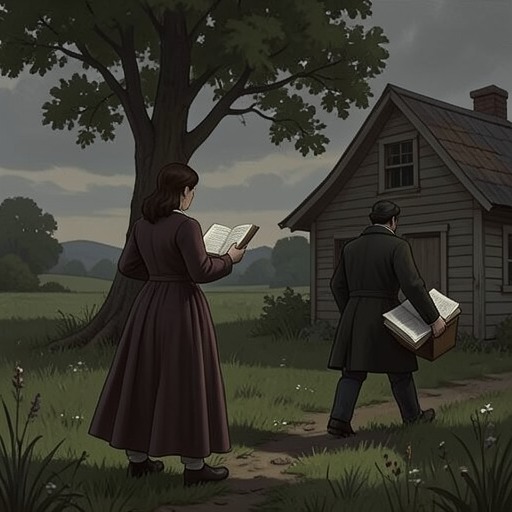
Mo’s First Shift at the Blue Glacier
How to Flirt with A Naked WerewolfMo’s First Shift at the Blue Glacier is the turning point at which Mo Duvall-Wenstein’s plan for an idle life in Grundy gives way to useful work, local belonging, and an economic stake in the community. What begins with Buzz DuChamp’s injury becomes a test of competence under pressure: Mo cleans the kitchen, takes over the grill, feeds a busy lunch crowd, and discovers that the skills she thought belonged to an earlier life can give her a new place in the present.
An Emergency Created by Injury
The shift begins in disorder. The Blue Glacier’s menu is ordinary all-American diner fare—burgers, fries, enormous pancakes, bacon, eggs, and repeated variations on steak—much like the food Mo had prepared while working her way through school at the Tast-E-Grill Drive-In. That experience makes her the only immediately available person who can plausibly take control when the kitchen falters.
Buzz initially resists giving up his grill, but his attempt to continue ends when he turns pale, breaks into a sweat, and leans on Pete. The accident is not a minor interruption: Buzz has severed a tendon in his finger and must travel 127 miles to Dearly for surgery. His fear of needles makes the medical trip an additional ordeal, while Evie DuChamp is left to keep the saloon functioning. The crisis therefore converts Mo from a customer and near stranger into the person on whom the kitchen’s immediate survival depends.
Mo Takes Command of the Kitchen
Mo accepts the work before she has fully absorbed its implications. The preparation is already partly complete: hamburger patties have been shaped, vegetables chopped, and orders are close to burning on the grill. After putting on rubber gloves, disinfecting the areas affected by the accident, washing her hands, and lowering the heat on the large griddle, she reconstructs the kitchen’s system from the supplies Buzz kept in careful bulk order.
The first plates establish her practical authority. Mo sends out two steak-and-egg plates and a tuna melt, then works through the next several hours of constant orders. Her hands remember the summers spent at the drive-in; the grease, sounds, and smells return with almost mechanical familiarity. The setting differs, however. At the drive-in, conversation had been enclosed behind car windows, whereas the Blue Glacier surrounds her with the murmur of customers and the social exposure of a small town. Customers praise the food and ask Evie about the new girl behind the stove, while Mo keeps her head down and lets the work speak for her.
The labor is physically costly. By the time Ben arrives to relieve her, Mo’s feet ache, her sweater is stained with splattered grease, and she is up to her elbows in dishwater. Yet the exhaustion confirms rather than cancels the shift’s value. She has not merely assisted during a mishap; she has demonstrated that she can keep the kitchen moving when the regular cook is absent.
From Substitute Cook to Employee
Evie’s offer makes the emergency permanent. Pete can crack eggs and chop vegetables, but he becomes flustered during a rush and cannot run the kitchen consistently. Evie also explains that Buzz’s domineering direction is part of the reason Pete has sometimes left the kitchen crying. Against that unstable division of labor, Mo represents steadiness, competence, and self-control.
Evie’s assessment rests on observable conduct rather than sentiment. Mo does not faint at the sight of blood, helps a near stranger, cooks reliably, and leaves the tip jar untouched despite having opportunities to take money. Evie therefore asks whether she would work full-time while Buzz is away and possibly take over the baking. The offer challenges Mo’s stated intention to remain idle in Grundy, but the kitchen has already given her a form of privacy within participation: she can belong to the room without being exposed to every part of it.
Mo accepts because the saloon offers more than employment. She likes the friendly voices and chatter, likes being near Evie, and feels that the work is a small step into the community. Her decision transforms a chance rescue into a chosen attachment. The Blue Glacier becomes the place where her competence is recognized and where social inclusion arrives through repeated, practical service rather than formal welcome.
Menu Reform and Expanding Authority
Mo’s first shift also plants the basis for changing what the Blue Glacier serves. After the traumatic aftermath of John Teague’s attempted robbery and assault of Mo, she cannot settle at home; instead, she uses her restless energy to prepare a detailed menu proposal. She works through recipes, cost analyses, and shopping plans, then brings Evie a program of reasonably priced comfort foods: chicken noodle soup, beef stew, meat loaf, chicken pot pie, chicken and dumplings, burgers, and melts.
The proposal extends beyond the grill into baking and desserts. Mo includes an improved apple-raisin pie, chocolate chess squares, applesauce cake, banana pudding, and brownie à la mode. Evie has wanted to revamp the menu but has lacked control over the cooking, so the new dishes represent a shift in operational power. The two women even plan to replace the menus by telling Buzz that Pete dropped them in the sink, a comic deception that acknowledges how difficult reform would be if Buzz retained unquestioned authority.
The menu is thus a material record of Mo’s integration. She does not simply occupy a vacant station; she brings an inherited and learned repertoire into the saloon, recalculates its costs, and helps redirect its identity. Food becomes the medium through which her past work, present usefulness, and future influence converge.
Lasting Consequences for the Community
The first shift’s consequences continue long after Buzz returns. Mo’s work strengthens her friendship with Evie and places her at the center of the Blue Glacier’s social network. Later, Evie and Buzz offer her a 20 percent share in the saloon because receipts have increased by at least that amount since her arrival. They also prepare a small nursery in the office so Mo can continue working after maternity leave, making the workplace compatible with her marriage to Cooper Graham and impending motherhood.
The saloon’s hospitality extends into the wider conflicts of the story. It is where Mo encounters returning acquaintances and politically significant visitors, including Eli, who appears at her table and expects the authority of someone accustomed to having orders obeyed. It is also a place where friendships can be repaired: after a disagreement with Evie over werewolf matters, the two share drinks and Sandra Bullock-based confections, and the experience restores their bond. The Blue Glacier’s ordinary service functions as a bridge between personal intimacy, town life, and the concealed werewolf society surrounding Grundy.
Mo’s first shift therefore changes the value of her position in several stages. She begins as an outsider seeking rest, becomes an emergency replacement, proves herself a reliable cook, earns the right to redesign the menu, and ultimately receives ownership in the business. The decisive significance of the event lies in that progression: labor does not merely occupy Mo’s time but gives her privacy, income, relationships, authority, and a durable claim to Grundy as home.